

Need Immediate Help? Call Toll Free 800.866.6689
Designed to meet your needs
The CASE System was developed only after we used Six Sigma principles to listen to our customers. As a result, it addresses your need for productivity-enhancing ease of use, powerful diagnostic tools and leading-edge networking alternatives. And its open architecture accommodates a range of increasingly powerful capabilities.
Innovative ergonomics
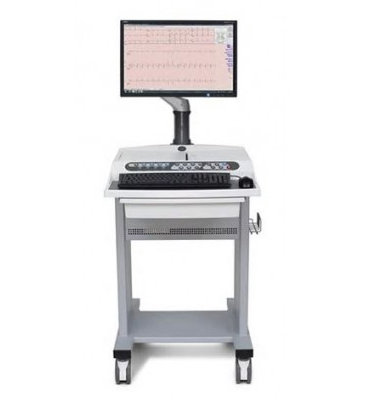
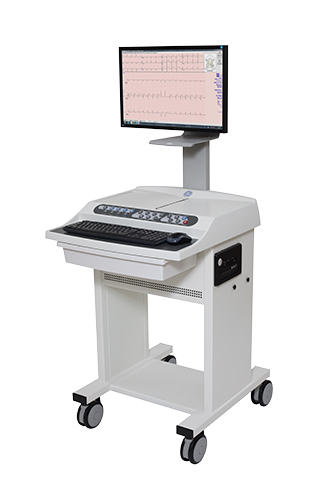
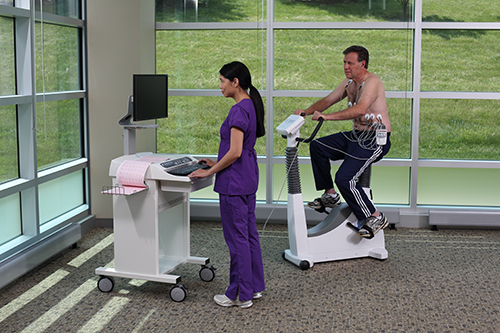
The CASE System's exclusive ergonomic features include a backlit keyboard and well-lit printing surface for effortless and confident operation in rooms darkened for stress-echo tests. A centrally mounted, full-size monitor swivels for comfortable viewing. A familiar, Windows XP-based interface and dedicated hard keys minimize the learning curve. And a flexible interface accommodates multiple custom set-ups, to meet the review and reporting preferences of any physician.
Enhanced diagnostic confidence
CASE offers a variety of powerful analysis tools and easy-to-use applications to optimize clinical decision-making including robust analysis and measurement algorithms. Multi-lead arrhythmia detection. And advanced assessment tools such as the proven 12SL computer-interpreted 12-lead ECG analysis.
It also gives you access to such capabilities as full disclosure, incremental updating, Duke Treadmill Score, cubic spline and automatic arrhythmia detection. And its signal-acquisition advances and innovative filtering including Finite Residual Filtering are complemented by user-adjustable controls for performance fine-tuning.
High-productivity networking
CASE can also be configured to meet information-management requirements from the simplest to the most sophisticated. For example, it accommodates bi-directional network communications for remote access to MUSE-stored patient records. Gives you the ability to export Adobe pdf and Word files, as well as XML and ASCII measurement data. And lets you seamlessly retrieve reports stored on the MUSE system even echo and nuclear procedure reports.
Performance Specifications
Instrument Type
Cardiac stress testing system with 14 channel acquisition and programmable lead configurations. Pentium-based, XP technology platform and hard drive storage deliver local and Catalyst MUSE database access.
Signal Processing
- ▣ ECG analysis frequency: 500 Hz
- ▣ ST measurements: ST amplitudes, slope, integral, index, ST/HR slope, ST/HR loops, ST/HR index up to 15 leads E, J and post-J point: Manual or computer selected
- ▣ Signal processing technique: Incremental median updating
- ▣ Baseline correction: Cubic spline or Finite Residual Filter (FRF) algorithm
- ▣ QRS detection and analysis: Based on automatic or manual lead selection
- ▣ ECG output: Real-time ECG/QRS beep/ITL synchronization output
- ▣ Heart rate: Automatic arrhythmia detection, documentation and annotation
- ▣ Full disclosure ECG: Beat-to-beat ECG record and event review
- ▣ Reanalysis: Post-test medians measurements from E, J, post-J point selections
- ▣ ECG interpretation: (Optional) 12SL adult and pediatric ECG analysis program
- ▣ Additional ECG function: Vector cardiography
- ▣ Technology: Active, Type BF floating isolated powered 14 channel acquisition module with built-in lead-fail detection and lead prep impedance measurement
- ▣ Sampling rate: Over-sampling @ 4000 Hz, 12 leads
- ▣ Dynamic range: 320 mV, 10 mV signal superimposed on 150 mV DC offset
- ▣ Resolution: 4.88 V/LSB @ 500 Hz
- ▣ Noise: < 15 V peak-to-peak noise over 0.01 to 150 Hz (-3 dB) bandwidth
- ▣ Frequency response: -3dB, display and writer
- ▣ High pass filter: 0.01 (or 0.05 Hz, special use) with DC offset control
- ▣ Low pass filter: 20, 40, 100, 150 Hz (selectable)
- ▣ Line filter: 50.0 or 60.0 Hz notch filter (selectable)
- ▣ Baseline correction: Cubic spline algorithm Artifact/baseline correction: FRF algorithm
- ▣ Common mode rejection: > 140 dB (123 dB with AC filter disabled)
- ▣ Input impedance: > 10 MQ @ 10 Hz, defibrillator protected
- ▣ Patient leakage: < 10 A
- ▣ Pace detect: Orthogonal LA, LL and V6; 750 V @ 50 s
- ▣ MUSE CV systems compatible via diskette; network (optional)
- ▣ MUSE CV Web compatible for retrieval view and printing of MUSE CV system data
- ▣ Local storage: Minimum 10 Gb hard drive storage of complete ECG record and test results
- ▣ Adobe PDF export of final reports
- ▣ Microsoft Word export of configured reports
- ▣ XML or ASCII export of specified data
- ▣ Display type: High resolution, color raster-written CRT
- ▣ Display resolution: Minimum 1024 x 768 x 70 Hz refresh
- ▣ Display size: 17 inch diagonal SVGA
- ▣ Monitored leads: 3, 6, or 12
- ▣ Displayed leads: Number on screen 3 or 6 (12 lead check)
- ▣ Display format: 3 rhythm, 3 rhythm + medians, 3 rhythm + trends, 6 rhythm, 4 x 2.5 + 1 rhythm, 2 x 6
- ▣ Display speeds: 25, 50 mm/s
- ▣ Display sensitivity/gain: 2.5, 5, 10, 20 mm/mV
- ▣ Displayed vital signs data (configurable): Heart rate, target heart rate, blood pressure, exercise clock, stage clock, phase clock, protocol, speed, grade, Watts, METS, RRP, and SpO₂
- ▣ Displayed data: ST scan/median complexes, arrhythmia's, ventricular ectopic/min counter, 3 to 15 waveforms, lead check torso and 12 leads, waterfall display, trends, tabular summary, stored ECG strips, interpretation, time-of-day clock, patient name, warning messages and prompts
- ▣ Writer technology: Instant load, thermal dot array
- ▣ Writer leads: 3, 6, 12 or 15 leads (standard, NEHB, Cabrera, configurable)
- ▣ Writer speeds: 5, 12.5, 25 and 50 mm/sec ( 2%)
- ▣ Writer sensitivity/gain: 2.5, 5, 10 or 20 mm/mV ( 5%)
- ▣ Writer resolution: Horizontal 1000 lines/sec x 200 dpi dedicated local printing. 200 x 200 dpi generic printing
- ▣ Paper type: Thermal, perforated, fan fold, 300 sheets/pak
- ▣ Paper size: A size 214.63 x 280 mm; A4 size 210 x 297.5 mm
Environmental Specifications
Power Requirements
Power Supply: AC operation only
Operating voltage range: 100-135 VAC; 45-63 Hz, 2.8 A; 180-240 VAC; 45-63 Hz, 1.4 A
Power Consumption: 350 W max; < 250 W normal; < 30 W standby
Operating Conditions
Temperature: +10 to 40C
Humidity: 20 to 95% RH non-condensing
Pressure: 700 to 1060 Kps
Storage/Transport Conditions
Temperature: -40 to +70C (paper discoloration may occur at high temperatures)
Humidity: 15 to 95% RH non-condensing
Pressure: 500 to 1060 Kpa
Physical Specifications
Height: 125 cm with no monitor installed
Width: 62 cm with paper tray removed
Depth: 75 cm
Weight: 68 kg without monitor
Interfaces included:
Acquisition module
Keyboard (PS/2) anti dedicated stress keypad (USB)
Mouse (PS/2)
Built-in thermal printer (USB)
10 Mbps Ethernet MUSE compatible
6 serial ports: (COM 1-2, COM A-D) - treadmill, BP, ergometer, SpO2
4 analog and 1 TTL (trigger) output - analog ergometer, camera synch, etc.
Diskette drive: 3 1/2 in, 1.44 Mb
PC-compatible for data storage
CD-R/W drive: Readable for software updates; archival data optional
Certification
UL, CE marking indicating compliance with the Medical Device Directive 93/42/EEC
 GE CASE Stress System